Thursday, 30 March 2017

Team Madagascar

I'm living in a fairly closed community, only due to its remoteness and because it's difficult to get to (I haven't taken orders... it isn't that life changing!). I think, strangely, it's what I like best and least about my time here.

Fortunately I get to share it with some lovely, fun people. I'm one of two volunteers, the other being a 19 year old American lad, who's also half Burkina. Obviously we're culturally and generationally poles apart but he's proving to be a great companion.


We live with our guide Rene who is also, most importantly, our interpreter. He's super cool and spends his spare time playing and writing music. He occasionally gets a break from us and Ludovic replaces him.


There are also 2 guardians and they swap out every fortnight which shakes it up a bit. Their main responsibilities are security, keeping the forest paths clear, chopping firewood, watering the veg patch and collecting water for the camp. Here are Nambini and Dodo after their rounds in the forest...


Each day a couple come in from the local village which is about an hour by foot and canoe, in all weather. Sana cooks and Solo is responsible for the canoes and is also the oracle on all things in the Reserve, being the longest serving member of staff... and occasional camp barber. 


On Sundays the guardians, Rene, Malick and I are left to fend for ourselves. Sunday lunch, which is always a bit of a treat.. spaghetti rather than rice, is usually prepared by me and Malick and  accompanied by a tasty courgette and tomato sauce!


Occasionally we need extra labour to canoe in supplies or when felling and chopping the non endemic trees. These guys are supernaturally strong, carrying tree trunks on their shoulders through the forest paths; amazing. 


The work squad:


Sunday, 19 March 2017

Saturday, 18 March 2017

The Working Week

I'm becoming dangerously used to a snooze in the middle of the day! We work 8-12am and then 2-5pm which leaves 2 blissful hours in the middle of the day for lunch and a siesta; perfect. The working week is Monday to Saturday with Sundays off, although, if we feel we've had a productive week, we give ourselves Saturday afternoon off as well!

The work varies and we're pretty much left to manage and organise ourselves with just high level objectives shared at the beginning, during my induction.

The work is split in to:

Maintenance - making sure existing paths and buildings are holding up. This is the team painting the dining hut and also fixing the roof of my house. Everything rots or is eaten so quickly here.


Conservation (of the forest) - which includes collecting seedlings nurturing them and planting areas that need regeneration. There are also several introduced Filao trees (Casuarina) that need to be removed.


Conservation (of the mangroves) - to the west, the Reserve is bordered by 2km of river and there is ongoing work to regenerate the banks by planting mangroves and we have been continuing that with survey work, report writing, signage and education.


Wildlife - continuing habituation of the lemurs at Sainte Luce which is a great excuse to walk in the forest early in the morning and at night to cover the diurnal and nocturnal species. There's a fairly resident group of Red Collared Brown lemurs, the only diurnal species, who we get to stalk quite often! I've noticed a marked reduction in the level of noise when we see them now which, in my lay person's view, means they're becoming more comfortable with us..... although it does make them harder to spot!


We regularly see Southern Woolly lemurs and Fat Tailed Dwarf lemurs on the night walks and occasionally we see these cute Gray Mouse lemurs.


We're also adding to the list of species seen at the Reserve and have managed to add 3 bird species with photographs. We saw this lovely Pitta-like Ground-roller roosting during a night walk.


This black crowned night heron was one of three we saw from the canoe one morning. Even our local guru and canoe guide had never seen them before so it was great to capture them on camera.


While walking the forest one day we found a giraffe necked weevil and they're not supposed to be here so that was a surprise and something for the Reserve to publish to the wider community.


In February I was up at 5am three mornings a week to walk the beach at dawn looking for any sea turtle egg laying signs. We never did come across any but we were rewarded with some stunning sun rises.


Projects - things that we can think of that would be useful. We've had great fun designing a board game with flash cards to help the staff with their English and us with our Malagasy. Also we've built an extension to the tree nursery and this is us passing and tying in the roof.


Education - we're putting together a lesson on mangrove conservation for a couple of the schools nearby, well a half hour canoe trip and then a 1km and 4km walk! 

Sainte Luce Reserve

Sainte Luce is a fragment of a fragment of littoral forest, which is coastal rainforest, now in short supply in Madagascar. There are only three fragments left down in the south east of the country and unfortunately on the largest of these Rio Tinto have been granted mining exploration rights in their quest for ilmenite (the mineral that, makes products such as toothpaste white).

To reach the Reserve we headed out of Fort Dauphin in a 4x4, loaded up with a week's vitels for the camp, for the initial leg, the 65km road trip..... well I say road:

Two and a half hours later we stopped, in the middle of nowhere, at another rickety river crossing with 2 dugout canoes waiting to transport us onwards:

After about 40 minutes of paddling and having been asked to stop wriggling so much, as I tried to look right, left, back and front all at the same time, we arrived at this rather smart looking dock:

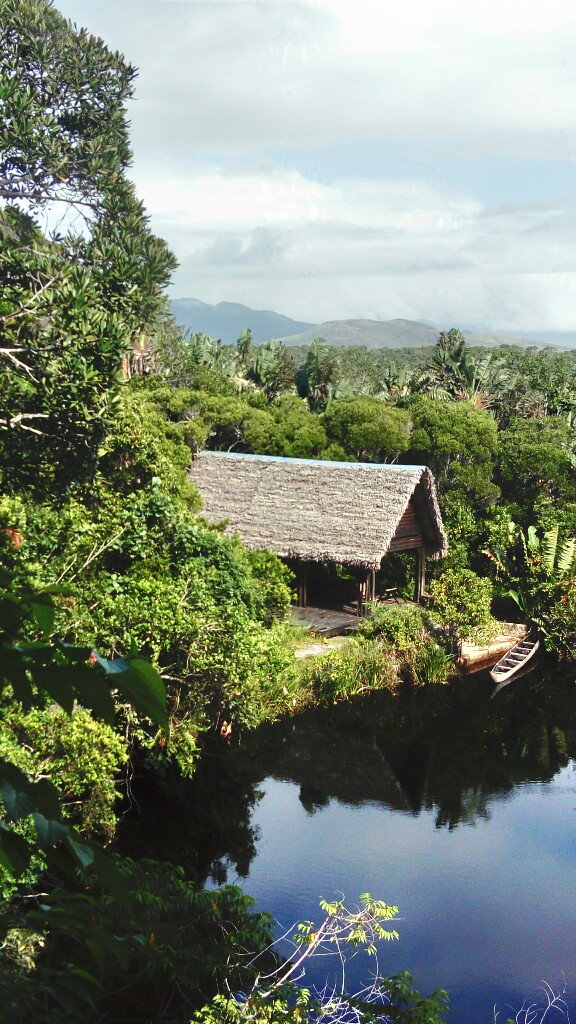
Good things continued to happen as I was offered this lovely little bungalow which makes a much more comfy home for the two months than my tent:

Although small, the Reserve exists to protect several acres of primary forest which extend down to a picture postcard beach to the east, with the tranquil, meandering Elimont River wrapping around the rest of it.


We generate solar power which is enough to charge torches and phones and give us light in the evening, provided the sun has been shining in the day! I haven't heard a motor here at all which is blissful. The overriding sounds are the ocean which is pretty powerful on this coast and then the cicadas, crickets and frogs. Oh, and the other is thunder, wind in the palms and torrential rain on the tin roof of the dining hut - but it is the rainy season!


Saturday, 25 February 2017

Madagascar

I'm now in Madagascar; a dream come true. I don't really have any preconceived ideas except that it will be different and I will see things I've never seen before.

Arriving in Antananarivo (Tana), the capital,  I stayed in Ivato, near the airport, as I was flying down to the south east early the next morning. I had to venture out to dinner, a 15 minute walk accompanied by the hotel guard to show me the way. We threaded our way through narrow streets busy with people and lined with small wooden houses, many doubling as shop fronts. The people are an intriguing mix of Africa and Asia (their forebearers coming from Indonesia/Malaysia 1000s of years ago.  When I walked into the restaurant I could have been in France... the decor, the menu, the bar. The meal was delicious accompanied by a tropical downpour thundering down on the roof and windows reminding me where I was. I didn't know that, due to a power shortage, electricity is switched off between 7-9pm, (and 9-11am), every day. Now I had to negotiate, in total darkness, streets that had turned into rivers, competing for the dry ground with a lot of other people. Fortunately at a particularly tricky section my friendly guard found me and by the weak light from his 'phone we completed the journey.

My destination the following day was Taolagnaro, previously known as Fort Dauphin. I stayed in a lovely bungalow looking out over the Indian Ocean with stunning sunset views from the garden sofa and from the bar 2 doors down! 


I had my orientation for the project and also had a chance to wander around the town. 

The market:

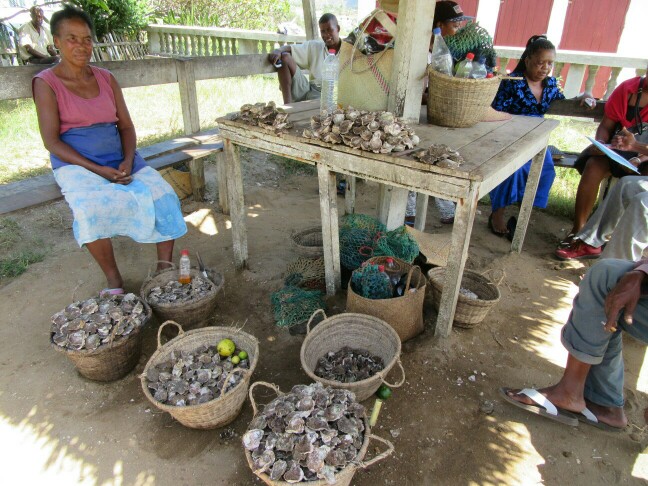
Oyster sellers:

Fort Dauphin is famous for the oldest building in Madagascar, a 1504 fort, and lobster, most of which is exported. Pirouges, dug out canoes, litter the beaches and they use them with sail and paddle to fish but without outriggers which looks pretty unstable to me.


Next stop Sainte Luce Reserve...

Monday, 20 February 2017

Moving on Up

I flew via Nairobi to Antananarivo (Tana) in Madagascar and was spoilt with this wonderful view of Mounts Kilimanjaro and Meru.


Then I had my first views of Madagascar, the fourth largest island in the world. Although, now I've experienced the state of the roads, it can feel like the largest island in the world!


Lack of sleep, rather than presence of alcohol, is responsible for the odd angle! 

Sunday, 19 February 2017

Brief visit to Bagamoyo


I need to be close to Dar for my flight to Madagascar but don't want to be in the city and so have come to Bagamoyo for a couple of nights. It's on the coast, 70kms north of Dar, which puts it a 2 hour drive to the airport at silly o'clock when I'm travelling but a 4 hour journey in Dar's notorious rush hour traffic.

For four short years, 125 years ago, Bagamoyo was the capital of German East Africa and before that it was an important coastal town for trade. With this in mind it's not surprising that many of the sights are now fairly crumbly.

The German boma - administrative building:

The German customs house:

The most exciting and lively part of Bagamoyo today is the beachfront fish market preparing and selling the day's with neighbouring stalls selling delicious deep fried fish and the dhows, sails billowing, in the background out at sea.


As the town's importance has waned so too has the wealth of the people and there are warnings to take care of your possessions. However, I found it friendly and welcoming. I chatted to the men playing the ubiquitous chequers game and then discussed world politics, the royal family and fishing with other interesting characters I met!


Monday, 13 February 2017

Kichangani

In Kichangani, (and Tanzania as a whole), most people farm some land. If you're a resident you're entitled to buy up to 5 hectares from the village council. In some villages I was told that each family were given a set number of hectares. Otherwise livelihoods are made by keeping shop, running market stalls, teaching, weavering, driving piki-piki taxis and chefing at food stalls. Here are some of my memories of the people and places in the village. 

Rice and beans - 5 different varieties! 

Onions, tomatoes and aubergines - to mix it up a bit 

Pounding.... beans

Weaving the local reeds

Piki-piki taxi loading up in the centre of the village 
Delicious fried banana snacks

Always a fast and furious, competitive draughts game going on with the men 

Farewell Kichangani


I am really sad to be leaving Kichangani and the friendly people who have made me so welcome.  Also it's a bit of a wrench to leave the project when there's still more that can be done.

My home was on the edge of the village, about a 10 minute walk to the centre where there was electricity to charge torches and phones. Pretty much everyone was calling me, "Deb-oR-ah", by the time I left,  particularly the women and the children. Walking in took longer as I stopped to chat, bump knuckles or shake hands. If I wasn't called by my name it was Mamma, Sister, Teacher, Mister and even Grandmother on one inauspicious day!

The walk into town 

Checking on the older children's homework progress 

My daily chaperones